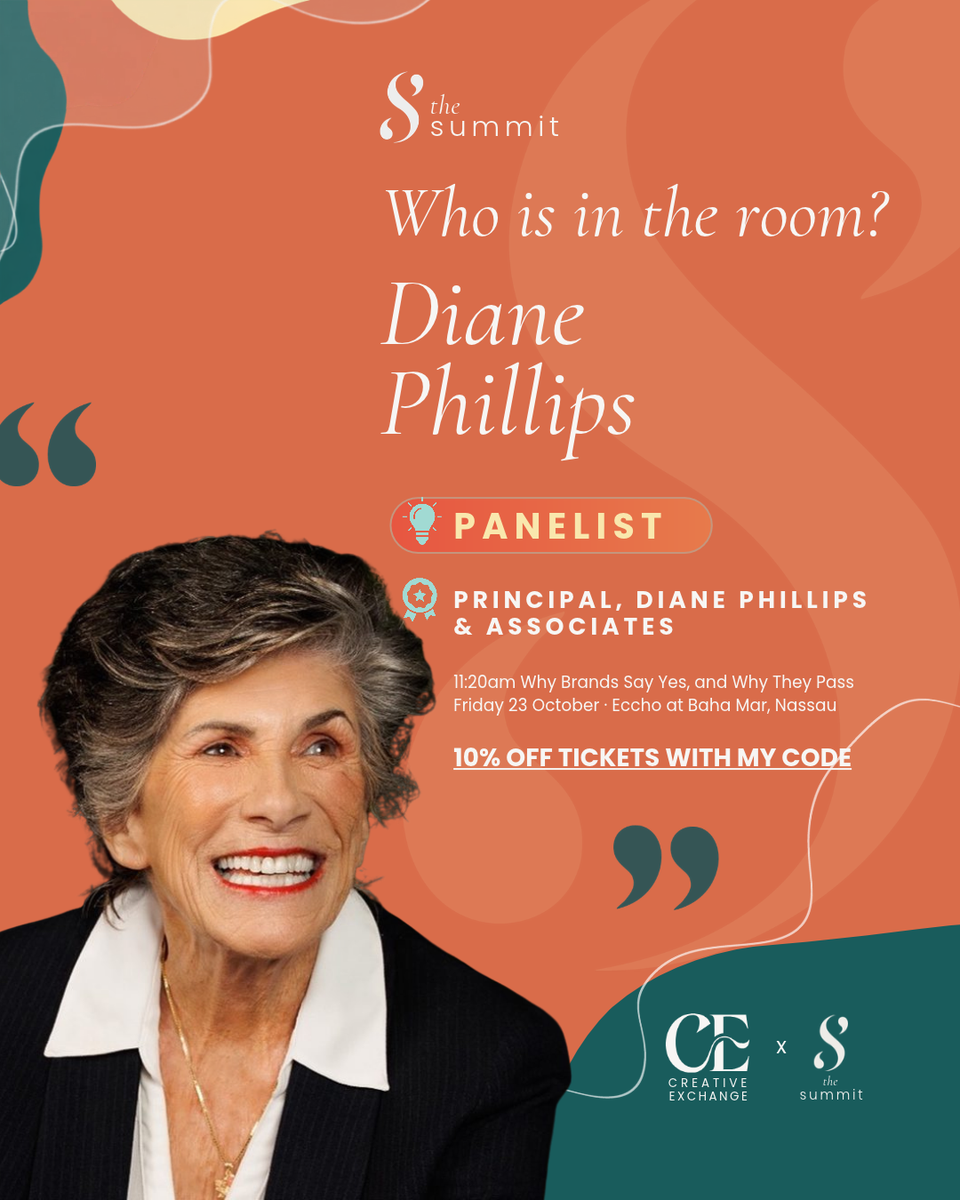
If you are reading these words on publication day, October 16, it’s likely I will be delivering similar ones to the most unlikely of audiences – high level content creators. The fact that I was invited to speak to a group of renowned people who do what I have absolutely no idea how to do was as anathema to me as those creators believing that banking is something you do inside a bank. Yet the invitation to address such a group of hundreds at a gathering organized by Janay Symonette and Bevy Agency with world-famous creators was too tempting to ignore and too challenging to refuse. Besides, there is nothing like a good challenge to keep the mind greased and the body refreshed. Considering for one split second, then rushing ahead to take on challenges, goals, new opportunities makes the difference between staying relevant and becoming a relic.
So what does someone like me have to offer to those who can whip out a Tik Tok video faster than I can sign into my account? They want to know about branding. I want to know how to turn my playlist into a user-friendly Spotify whatchamacallit.
Another pot of coffee later – yes, a pot, not a pod – and I understand the connection between their world and mine, the one I started in half a century ago and have plodded through every day since, most holidays included. It’s all about messaging, Theirs is a world built on how the messaging looks, sounds, feels, smells when it is delivered and how the messenger is perceived. Will he or she move up in the rankings? Will they be recognized and rewarded? Mine is based on the news and information it delivers, Theirs has pizzazz. It’s fun. Or it is intended to be fun. You don’t see content creators reporting a murder or revealing the latest twist in a scandal. Mine is hard news, features, human interest, the story of a child with special needs who stuns everyone with a singular engineering feat.
We are not so different as we are similar in many ways. I won’t be posting about the hottest look in sandals. They won’t be creating content about pending legislation, But both of us will jump on it when there is a matter of public interest – their posts on saving the environment will be every bit if not more powerful than mine. Their recipes for a perfect holiday meal might take a few shortcuts but if I write tight, mine will be similar.
There is one distinct difference. As they build their brand, what they do is about them. As I, others who do what I do, do what we do, build our portfolio of work, we build relationships with people upon whose good graces we depend – the media. We build relationships with clients whose stories we tell and whose products or services may benefit from some advice and counsel. We help them build relationships through networking. We are the connectors. Our, meaning traditional media, messages and social media messages, while often be worlds apart, may also overlap, one reinforcing or re-affirming the other. Voices coming from different places with a single thread of thought. But their delivery has to be slick and compelling to compete for attention from a global audience that is information fatigued. Our message doesn’t need a slick or snazzy coating. It needs a compelling content that is based on fact, knowledge, assessment not just of what this sliver of news means for today but what impact it can have on tomorrow.
Their success is based on who looks at what they produced today and follows them into tomorrow. It is about them. Ours is harder to measure. It is not about us. Or rarely about us, though the lines are more blurred as newscasters become quasi-TV stars and anchors have their own following. What Jennifer Lopez did as a pioneer in personal branding turning voice, acting and body into the J.Lo brand with great forethought, planning and execution, the tragic, unsolved disappearance of Savannah Guthrie’s mother did for her and The Today Show organically. No one plans a tragedy. Millions follow it.
For those of us who have long been at this work of reporting, providing information, building news libraries and helping to mark or write history, there is one element that will always distinguish what the Alex Wolff’s do from what we did – it’s the how, the means and methods.
When I began my career as a teen columnist at 14, I rode a bike and collected photos which I carried back to the Boca Raton News where they let me write a teen column. In high school, I produced the Teen Town News, a black and white mimeographed 11×14 tabloid with all the latest school news and gossip. Every Friday night I ran if off on a mimeograph machine, turning the big wheel that spun paper through. It was so popular that I doubled the price from five cents to a dime and still sold out every week. As a reporter later for the Palm Beach Post and running the South County bureau, I covered city council meetings, elections, civil rights movement, FAU still in its infancy, crime and fire. What I followed was a police radio and my contacts in police and fire in the multi-city area were strong. If a fire broke out or there was a drug bust at some ungodly hour, the phone would ring. I knew their voices, they didn’t have to identify themselves when they dropped a hint about where to go. I grabbed my young daughter, threw her on the blanket that I kept on the floor of my El Camino truck and off we went in the middle of the night to cover the action. After a City Council meeting, I dropped a dime or a quarter, I don’t remember which, into the pay phone in the hall and dictated the story. I wrote it as I spoke it, though sometimes I usually knew the lead by the time I was done dialing the number for City Desk.
At the National Enquirer and Weekly World News where I worked for the legendary Generoso Pope, we had the best of everything, the newest, finest equipment. It took an artist to photoshop a photo of Elvis or Carole Burnett or Mary Tyler Moore. Pope wanted to bring in these new electric typewriters and every writer got one – and almost every writer rejected. After two weeks, they begged to go back to manual. The sound of the electric motor was too much pressure to produce the next few words.
The IBM Selectric with its ink ball revolutionized the act of telling a story. It was a marvel. Less than six months after it was introduced in 1961, there were orders for 80,000. By 1986 – just 25 years later – there were 13 million IBM Selectrics in use. When I moved to the Bahamas 44 years ago, I worked on one and found it amazing state-of-the-art – until the even more amazing word processor came along and you could go back and correct a mistake up to 17 letters back without having to start all over again.
It all seems like ancient history now yet it was not that long ago, but the world of how we write, how we tell our story, how we attract those who will follow faced its greatest change when the PC was invented. Nearly 220 million laptops have been sold. In 2025, the total number of laptops and desktops reached 278 million creating a $250 billion market with all the accessories. Stories began to spread via phone, first text, then all the social media channels a Smart phone could get. Memes flew back and forth faster than all the airplane in the sky at any given time. Today there are eight billion cellphones in use, the equivalent of one for every man, woman, child and infant.
So where does this leave us?
Content creation is not new. What is new is the means by which it is done. For all the greats like TV host and creator Lolo Wood; Alex Wolf, one of Fast Company’s 100 Most Creative People in Business; and Grammy-winning producer Bryan-Michael Cox, there were the predecessors of Edward R Murphy and Barbara Walters and Bob Woodward whose reporting brought down a president and Brian Moss who with the testimony of people like Norman Solomon brought down the Colombian flag that flew over Norman’s Cay and the shame that smeared The Bahamas for its blatant condoning of the drug trade.
And here is the lesson to take home from all of this, if there is a lesson to be learned. In the end it is not the means of the message, but the relationships that you build. No matter how easy it is to post something and never have to connect with a human by phone or flesh, when there is a crucial moment and you need that friend or source or person of influence there is no technology that substitutes for a human and the personal touch. Do not get swept away by the metrics. In thee end, it is people and relationships that matter.